
A living room partition isn’t just about dividing space, it’s a practical solution that adds character, improves functionality, and refreshes your home without the cost and hassle of major renovation. Whether you’re looking to create a home office nook, separate a playroom, or simply add visual interest, living room partitions offer flexibility that permanent walls can’t match. Modern partition designs blend aesthetics with utility, giving homeowners control over their environment. This guide walks you through why partitions work, the styles that matter right now, and how to plan a DIY installation that actually fits your space.
Table of Contents
ToggleKey Takeaways
- Living room partitions provide a reversible, affordable alternative to permanent walls, costing $15–$60 per linear foot depending on style and materials.
- Open-frame and geometric partition designs maintain sightlines and airflow while defining zones, making them ideal for contemporary and minimalist spaces.
- Strategic partition placement using the 2:3 ratio rule—positioning off-center rather than dead-center—creates intentional zones without visually cramping the room.
- Secure installation requires anchoring top and bottom plates to ceiling and floor joists, proper leveling with a laser level, and quality fasteners like GRK or Spax screws to prevent structural issues.
- Glass panels and sliding barn doors preserve natural light while providing privacy, making them excellent choices for creating separate work or bedroom alcoves in open-plan living rooms.
- A basic DIY living room partition installation takes one weekend for a two-person team, with additional time needed only for drywall finishing or barnyard door installation.
Why Partition Walls Transform Your Living Room
Partition walls solve real problems that traditional fixed walls can’t. They carve zones without blocking light, allow you to adapt your layout as life changes, and cost significantly less than construction or removal. A well-placed partition creates a defined work zone in an open-plan living room, reduces noise between areas, and makes the space feel intentional rather than sprawling.
Unlike load-bearing walls, non-structural partitions don’t require permits in most jurisdictions (though always check local building codes, requirements vary). They’re also reversible. If your needs shift in two years, you remove or repurpose the partition without leaving permanent damage. This flexibility appeals to renters, families with changing routines, and homeowners who like to experiment with their layouts.
Partitions also improve the perceived scale of a room. A large, open living room can feel cavernous and echoey: strategic partitions break up the space visually and acoustically, making it feel more intimate and livable.
Popular Partition Styles for Modern Living Rooms
Open-Frame and Geometric Partitions
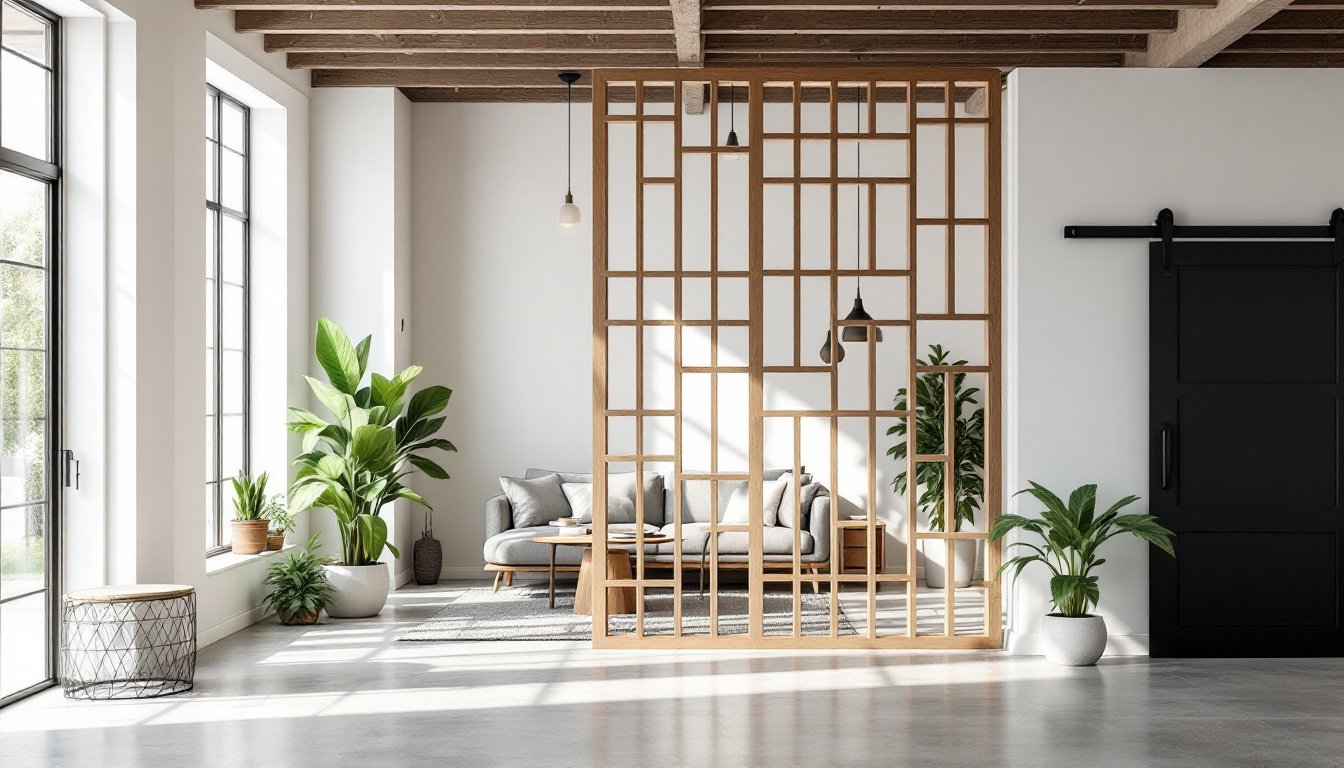
Open-frame partitions, think wooden slats, horizontal bars, or modular geometric grids, maintain sightlines and air flow while defining zones. These aren’t solid barriers: they’re visual breaks. A frame of 2×2 or 2×4 studs with infill (horizontal slats, metal rods, or lattice) works well in contemporary spaces and costs less than solid drywall.
Geometric partitions, featuring repeated patterns like hexagons or angular cuts, lean modern and are excellent focal points. They suit mid-century and industrial aesthetics. When building frame partitions, use quality fasteners, 3-inch screws work better than nails for structural stability, and ensure the top and bottom plates are shimmed level. An unlevel partition looks shoddy from day one.
Designers at Dwell frequently showcase open partitions in minimalist homes because they achieve separation without visual clutter. If you’re building one, prime and paint all wood before assembly to avoid lap marks and uneven finish.
Sliding Barn Doors and Glass Panels
Sliding barn doors pack tremendous style and practicality. A single 36- to 42-inch wide barn door on a track can separate a home office or bedroom alcove from your main living area. They’re less “farmhouse Instagram” and more architectural now, especially in black steel or natural wood finishes.
Glass panels, frosted, clear, or textured, offer another route. They block sightlines while preserving light. Frameless glass panels or those with minimal aluminum framing look clean and contemporary. Track-mounted glass sliding partitions work well in modern homes and are easier to install than building a frame wall because you’re not dealing with lumber tolerances and drywall finishing.
Both styles require a header (a horizontal support beam) mounted securely to ceiling joists. If your joists run perpendicular to your installation, drilling into them is straightforward. If they’re parallel, you’ll need to use blocking or a heavier header. Homedit has solid examples of how barn doors and glass integrate into real living rooms without feeling like afterthoughts.
DIY Partition Installation and Material Selection
Material choice drives both aesthetics and budget. Solid drywall partitions (traditional studs + drywall) run $30–$60 per linear foot depending on height and finish, but require mudding and taping skills. Open-frame partitions using 1×4 or 2×4 lumber and infill cost $15–$40 per linear foot and look clean with minimal finishing work. Sliding barn doors add $400–$1,500 depending on hardware quality and door material.
Before you order materials, measure twice. Account for floor-to-ceiling height (standard is 8 feet, but older homes vary), doorway openings, and any utility lines or fixtures that might block installation. Most building codes require 16-inch spacing between studs in non-load-bearing partitions, but confirm your local requirements.
For any partition installation, gather these tools: a stud finder (non-negotiable), a laser level, a cordless drill with bits, a miter saw or circular saw, and a tape measure. Don’t cheap out on fasteners, use GRK or Spax brand screws rated for your lumber type: they hold better than generic alternatives and won’t strip or snap as easily.
Start by locating and marking the top and bottom plate positions with chalk. Use the stud finder to locate ceiling joists and floor joists, you want top and bottom plates anchored to framing, not just drywall. If the partition runs parallel to joists, install blocking between them first. Shim everything level before fastening: an out-of-plumb partition compounds every finishing step.
Wear safety gear: eye protection, dust masks (especially when cutting lumber or drywall), and hearing protection if using power tools. Partition work is low-risk compared to electrical or structural projects, but precautions still matter.
For DIY timeline: a basic open-frame partition takes one weekend (two people). Drywall finishing adds another weekend or two depending on your mudding experience. Barn door installation, if your header is already in place, takes a day.
Maximizing Light and Flow With Strategic Partition Placement
Position your partition to work with, not against, natural light. If your living room has windows on one wall, avoid blocking that light entirely. Open-frame partitions are smart here because they cast shadows rather than hard barriers. Glass panels preserve light too: frosted or textured glass diffuses it and provides privacy without the cave feeling of solid walls.
Floor plan flow matters equally. Place partitions at natural sight-lines, perhaps creating a nook at one end of the room rather than cutting the space in half. An off-center placement often feels more intentional than a dead-center installation and doesn’t split the room psychologically.
Consider the 2:3 ratio rule from interior design: if your living room is 20 feet long, position a partition around 12–13 feet in, not at the 10-foot midpoint. This creates visual interest and functional zones that feel distinct without feeling cramped. Projects featured on Design Milk often showcase this principle, asymmetrical partitions that frame views and anchor furniture arrangements naturally.
Ventilation and air circulation matter too. Solid partitions trap air and can make one zone feel stuffy. If using drywall, leave undercuts (gaps at the floor base, typically 1–2 inches) to allow air movement. Open-frame partitions handle this automatically.
Conclusion
A living room partition brings purpose and personality to your space while staying reversible and affordable. Whether you choose an open-frame design, sliding barn doors, or glass panels, the key is honest planning, measure precisely, anchor securely, and don’t skimp on fasteners or finishing details. Start with a clear purpose (a home office zone, a play area, or visual interest), and let that drive your material and style choices. Your living room becomes exactly what you need it to be.